History of the Russian Empire
The Russian Empire was proclaimed on 22 October 1721, in the Trinity Cathedral of St. Petersburg, when Tsar Peter I, fresh from the Treaty of Nystad, took the title of Emperor and Autocrat of All the Russias. For the next 196 years, the empire he founded would stretch from the Baltic to the Pacific and from the Arctic to the Caucasus, project Russian power across three continents, and shape the lives of some 175 million people on the eve of the First World War. It ended in 1917, with the abdication of Nicholas II and the seizure of power by the Bolsheviks.
The story of the empire is a story of transformation. It begins with a small medieval principality in the forests of northeastern Rus, expands through conquest and dynastic union into one of the largest contiguous empires in history, and ends in the upheaval of revolution, civil war, and the rise of a new Soviet order. Along the way, the empire absorbed diverse peoples, languages, religions, and traditions, often by force and sometimes by accommodation.
Understanding the history of the Russian Empire requires looking at several overlapping dimensions: the political evolution from principality to tsardom to empire, the territorial expansion that made Russia a multi-ethnic and multi-confessional state, the social and economic structures that defined daily life for peasants, workers, nobles, and merchants, the cultural flowering that produced some of the world’s greatest literature, music, and art, and the internal contradictions that ultimately brought the imperial system to ruin.
The origins: From Kievan Rus to Muscovy
The historical roots of the empire lie in the early medieval state of Kievan Rus, a federation of East Slavic tribes centered on the trade routes between the Baltic and the Black Sea. Founded in the ninth century, Kievan Rus adopted Eastern Orthodox Christianity in 988 under Prince Vladimir the Great, an event that bound the region culturally and spiritually to the Byzantine world for centuries to come.
The Mongol invasion of the thirteenth century shattered Kievan Rus, leaving a patchwork of successor states scattered across the forested north and the open steppe of the south. The most successful of these northern states was the Grand Duchy of Moscow, which began as a modest principality serving as a tribute collector for the Mongol Golden Horde. By carefully navigating Mongol overlordship, accumulating land through purchase, marriage, and warfare, and playing rival Tatar factions against each other, the Muscovite princes steadily built a powerful regional state.
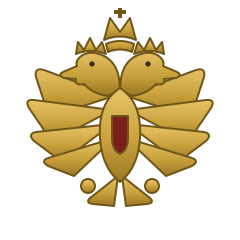
By the late fifteenth century, Grand Prince Ivan III, often called Ivan the Great, had consolidated much of northeastern Rus under Moscow’s rule. In 1472, he married Sophia Palaiologina, niece of the last Byzantine emperor, and adopted the double-headed eagle as the symbol of the Russian state. After the final collapse of Byzantium to the Ottoman Turks in 1453, Moscow increasingly styled itself as the “Third Rome,” the spiritual and political heir to the fallen Orthodox empires. The rise of Muscovy from tributary to sovereign marked the first great turning point on the road to empire.
The Tsardom of Russia
In 1547, Ivan IV, known as Ivan the Terrible, took the unprecedented step of being crowned as Tsar of All the Russias, claiming a sacred imperial authority derived directly from God and inherited from the Byzantine emperors. The new title signaled that Moscow was no longer merely a principality among many, but the center of a divinely sanctioned Orthodox state. Ivan’s reign combined dramatic territorial expansion, including the conquest of the Tatar khanates of Kazan and Astrakhan, with a brutal internal repression known as the Oprichnina, a reign of terror against the boyar class that left deep scars on Russian political culture.
The period that followed Ivan’s death was marked by a succession crisis, foreign intervention, and social upheaval known as the Time of Troubles (1598-1613). Polish and Swedish forces occupied Moscow, pretender tsars claimed the throne, and peasant rebellions convulsed the countryside. The crisis was ultimately resolved in 1613 when a national assembly, the Zemsky Sobor, elected the young Michael Romanov as tsar, founding the dynasty that would rule Russia until 1917.
The Romanov dynasty and the founding of the empire
The Romanov dynasty presided over the transformation of Muscovy into a true empire. The early Romanovs, including Michael, Alexis, and Fyodor III, consolidated royal authority, expanded into Siberia, and gradually extended serfdom as a means of binding the labor force to the land. By the end of the seventeenth century, Russia was a vast but backward state by Western European standards, with a relatively small urban population, limited industry, and a ruling class that had largely missed the Renaissance, Reformation, and Scientific Revolution transforming the West.
That began to change dramatically under Peter I, commonly known as Peter the Great, who ruled from 1682 to 1725. Peter traveled incognito through Europe in the Grand Embassy of 1697-1698, observing Western military, naval, and administrative practices firsthand. Determined to modernize Russia, he launched a sweeping program of reforms that touched virtually every aspect of Russian life. He founded a new navy, reorganized the army along European lines, established a Western-style bureaucracy, reformed the calendar, introduced new schools, and forced the nobility to shave their beards and adopt Western dress.
In 1703, Peter began construction of a new capital, Saint Petersburg, on land conquered from Sweden in the Great Northern War. In 1721, following the victory over Sweden confirmed by the Treaty of Nystad, Peter adopted the title Emperor and proclaimed the Russian Empire, claiming equal rank with the Holy Roman Emperor and other sovereigns of Europe. Saint Petersburg, with its grand European architecture and position on the Baltic, became the symbolic window through which Russia would henceforth relate to the West.
The eighteenth century: Empresses and expansion
Peter’s successors consolidated the imperial state while pushing its borders outward. Peter’s wife, Catherine I, ruled briefly after his death in 1725, and there followed an era of palace coups and short-lived rulers in which the throne passed to Anna (1730-1740) and then, after the deposition of the infant Ivan VI, to Peter’s daughter Elizabeth (1741-1762). The real turning point of the eighteenth century came with the reign of Catherine the Great, who ruled from 1762 to 1796.
A German princess born Sophie of Anhalt-Zerbst, Catherine came to power through a coup against her husband, Peter III, and went on to become one of the most consequential rulers in Russian history. She presided over a golden age of enlightened absolutism in Russia, corresponding with Voltaire and other philosophers, patronizing the arts, and attempting significant administrative and legal reforms. Her reign also saw the First Partition of Poland in 1772, the annexation of Crimea, and major military victories over the Ottoman Empire that established Russia as the dominant power in the Black Sea region.
Catherine’s son Paul I ruled for only five years before being assassinated in a palace coup in 1801, but her grandsons Alexander I and Nicholas I would dominate the nineteenth century. Alexander I led Russia through the Napoleonic Wars, ultimately defeating Napoleon’s Grande Armée in the catastrophic French invasion of 1812, and participating in the Congress of Vienna that reshaped post-war Europe. Nicholas I presided over a period of conservative autocracy, military intervention in Hungary, and the disastrous Crimean War of 1853-1856, which exposed the empire’s technological and administrative backwardness.
The nineteenth century: Reform, reaction, and revolution
The mid-nineteenth century was a period of great tension in the Russian Empire. The Crimean War defeat prompted a wave of reforms under Tsar Alexander II, who is best remembered for the emancipation of the serfs in 1861, the most sweeping social reform in Russian history. The emancipation freed millions of private serfs from personal bondage, but it left them burdened with heavy redemption payments and insufficient land, sowing the seeds of lasting rural discontent.
Alexander II also created elected local assemblies called zemstvos, reformed the judiciary, and expanded educational opportunities. However, his reforms were cut short in 1881 when he was assassinated by a bomb thrown by members of the radical Narodnaya Volya (People’s Will) movement. His successor, Alexander III, reversed many of the reforms and intensified the persecution of revolutionary movements, while industrialization began to gather pace in the 1880s and 1890s.
The late nineteenth century also saw dramatic Russian expansion into Central Asia, the Far East, and the Pacific. The construction of the Trans-Siberian Railway between 1891 and 1916 cemented Russian presence in the Far East and led to conflict with an emerging Japan. The Russo-Japanese War of 1904-1905 ended in a humiliating Russian defeat and was a direct catalyst for the Revolution of 1905, a mass uprising that forced Nicholas II to issue the October Manifesto, which established Russia’s first constitutional order and a parliament called the State Duma.
The early twentieth century: Crisis and collapse
The final period of the Russian Empire, between 1905 and 1917, was marked by accelerating crisis. The economy grew rapidly, but industrialization brought poor working conditions, urban overcrowding, and the rise of revolutionary socialist movements. Russia remained politically unstable, with a series of prime ministers including the reformist Sergei Witte and the more conservative Pyotr Stolypin attempting to modernize the state while preserving autocracy. Stolypin’s ambitious agrarian reforms sought to create a class of independent peasant landowners, but were cut short by his assassination in 1911.
World War I proved to be the final blow. Russia entered the war in 1914 as a member of the Entente and suffered catastrophic losses in the early campaigns of 1914 and 1915. Military defeats, food shortages, and government incompetence eroded support for the monarchy. In February 1917, a spontaneous uprising of workers and soldiers in Petrograd (as Saint Petersburg had been renamed in 1914) toppled the Romanov dynasty, and Tsar Nicholas II abdicated on 15 March 1917. The 300-year-old Romanov era was over, and the empire’s history was about to take a violent and unprecedented new turn.
The February Revolution was followed by the October Revolution of the same year, in which the Bolshevik party led by Vladimir Lenin seized power. A brutal Russian Civil War (1918-1922) followed, pitting the Red Army against a loose coalition of monarchists, liberals, and other factions known as the White Movement. The Bolsheviks prevailed, and in 1922 they formally established the Union of Soviet Socialist Republics, ending the territorial structure of the Russian Empire in all but name. The royal family had been executed in Yekaterinburg in July 1918, and the imperial order, which had once stretched across a sixth of the Earth’s land surface, was definitively a thing of the past.
Themes and legacies
Two centuries of imperial history left behind several patterns that continue to shape how Russia understands itself.
Autocracy, reform, and reaction. From Peter the Great to Alexander II to Stolypin, each attempt to modernise the Russian state ran into the same problem: the autocrat could not afford to give up the autocracy. Reform would address one set of crises while creating another. By the early twentieth century the pattern had exhausted itself, and the autocratic system collapsed under the strain of the First World War.
Russia and the West. Russian rulers oscillated between emulation of European models, rejection of Europe as decadent, and the search for a distinctive Russian path. Peter chose emulation, Catherine pursued selective engagement with the Enlightenment, the Slavophiles argued for an Orthodox and Slavic identity, the Westernisers for convergence with Europe. The tension remains central to Russian self-perception.
Governing a multi-ethnic empire. The Romanov state ruled over Russians, Ukrainians, Poles, Finns, Balts, Germans, Jews, Tatars, Georgians, Armenians, Central Asians, and many smaller peoples, who often resented Russian domination. The empire’s mixture of Russification, religious tolerance, regional autonomy, and repression held the system together for two centuries — and the failure of those policies helped to fuel the nationalist movements that tore it apart.
Culture and the state. Russian writers, composers, and artists were in constant dialogue with the imperial state, sometimes serving it, sometimes opposing it, and often producing works of the highest quality. The literature of Pushkin, Gogol, Tolstoy, and Dostoevsky, the music of Tchaikovsky, Mussorgsky, and Rimsky-Korsakov, the art of the Wanderers and the World of Art movement — all are products of this difficult engagement.
The contradictions of empire. The Russian Empire proclaimed itself a defender of Orthodoxy and a champion of European civilisation, while governing millions of non-Christians and non-Europeans. It claimed a mission of Slavic unity while ruling diverse peoples. It pioneered some of the most progressive reforms of the nineteenth century while persisting with serfdom and repression. It produced works of human imagination on a colossal scale, and it produced famines, pogroms, and revolutionary violence on a similar scale. The empire was, in the simplest summary, an empire of profound greatness and profound tragedy — and the tension between those two realities, unresolved in its own lifetime, has remained unresolved in the historiography and politics that followed it.
How the empire was organized
The Russian Empire was governed by an elaborate and constantly evolving bureaucratic apparatus. At the top stood the autocratic emperor, who ruled by divine right, controlled the army, the church, and the bureaucracy, and was not subject to any earthly authority. Beneath the emperor stood an increasingly complex hierarchy of ministries, the Senate, the Holy Synod (which governed the Russian Orthodox Church after Peter the Great abolished the patriarchate in 1721), and the State Council.
After 1905, the empire acquired a quasi-constitutional structure with the State Duma and an appointed upper house, but real power remained with the emperor, who retained the right to dissolve the Duma, veto its laws, and govern by emergency decree. The empire was divided into large administrative units called governorates (guberniyas), each headed by a governor appointed by and responsible to the emperor. Local government was conducted through zemstvos at the provincial and district level, but their powers were limited and they had no authority over the peasant masses, who were governed by their own commune structures.
The legal system combined elements of Byzantine canon law, local custom, and the imperial law codes issued by Peter the Great, Catherine the Great, and Nicholas I. The most famous legal code, the Svod Zakonov (Digest of Laws), was compiled in 1832 under Nicholas I and remained the foundation of Russian law until the empire’s end. The judicial reforms of 1864 introduced independent courts, trial by jury, and equal justice for all classes, but in practice the autocratic system frequently circumvented these reforms, especially in cases involving political dissent.
Economy and society
The economy of the Russian Empire was overwhelmingly agricultural, with the vast majority of the population living in the countryside and engaged in farming. After the emancipation of 1861, peasants remained the largest social class, although the nobility continued to own much of the land. The serf economy of the early imperial period gave way slowly to a market economy in the nineteenth century, and the late nineteenth century saw a rapid growth of railways, factories, and mining, particularly in the Donbas, the Urals, and St. Petersburg.
The social structure of the empire was rigid and legally defined. The Table of Ranks introduced by Peter the Great in 1722 divided service to the state into fourteen ranks, with corresponding privileges. Below the nobility stood the merchants, the urban petty bourgeoisie (meshchane), and the peasantry, which was itself divided into various categories. At the bottom of the social ladder stood the serfs, who in the early imperial period constituted nearly half the population and were essentially the property of their owners until the emancipation of 1861.
The cultural and ethnic diversity of the empire was enormous. Russians formed a majority in the core provinces, but the empire included large numbers of Ukrainians, Belarusians, Poles, Jews, Finns, Germans, Latvians, Lithuanians, Estonians, Moldavians, Georgians, Armenians, Azeris, Central Asians, and many smaller groups. The Russification policies pursued by Alexander III and Nicholas II sought to impose Russian language and culture on non-Russian subjects and fueled nationalist opposition, particularly in Poland, Finland, and the Baltic provinces.
The Russian Empire in world history
The Russian Empire stands alongside the Ottoman, Habsburg, Qing, and British empires as one of the great multi-ethnic imperial formations of the modern era. Like the others, it was built by conquest, dynastic marriage, and political opportunism, and like the others it eventually collapsed under the weight of its internal contradictions and the pressures of modern nationalism.
What set Russia apart from its peers was, first, the land-based character of its empire: built on the model of the Mongol successor states and extending across the Eurasian landmass, it was always less of a maritime and commercial power than its British or Dutch contemporaries. Second, Russia defined itself explicitly in religious terms as the defender of Orthodoxy, even as it extended protection over Muslims, Buddhists, Jews, and other confessions. Third, especially after the Napoleonic Wars, Russia was the great conservative power, repeatedly intervening to suppress revolution and uphold the monarchical order — a role associated with Nicholas I and the principles of Orthodoxy, Autocracy, and Nationality.
By 1914, Russia was still a great European and Asian power, with one of the largest armies in the world, a growing industrial economy, and vast natural resources. But the political stagnation, the social inequality, and the overstretch of the empire were beginning to tell. The First World War exposed those weaknesses, and the entire structure came apart with remarkable speed. The collapse of 1917 would shape the entire course of the twentieth century, paving the way for the Soviet Union, the Cold War, and the still-unfolding history of the post-Soviet states.
To understand the modern world, and especially the history of Europe and Asia, an understanding of the Russian Empire is essential.
Related pages
- The Early Romanovs: 1613-1682
- Rise of Muscovy and the Birth of Imperial Russia
- Peter the Great and the Birth of the Russian Empire
- Catherine the Great and the 18th Century Russian Empire
- Serfdom in the Russian Empire
- The Russian Empire in the 19th Century
- The 1905 Revolution and the Fall of Autocracy
- The February Revolution and the End of the Romanovs
- The Russian Empire in World War I
- Russian Imperial Economy and Society