When Was the Russian Empire Founded?
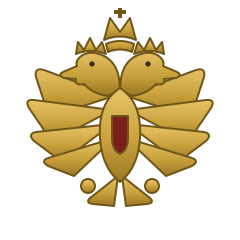
On 2 November 1721 (22 October O.S.), the day after the news of the Treaty of Nystad reached the capital, Peter I received the titulyarnik from the hands of his minister’s son, the young Prince Dmitry Galitzine, and took the title of Imperator i Samoderzhets Vserossiysky — Emperor and Autocrat of All the Russias. The ceremony took place in the Trinity Cathedral of the Alexander Nevsky Lavra in St Petersburg, before the Senate, the Holy Synod, and the four kollegia presidents. Archbishop Feofan Prokopovich of Pskov preached the sermon, “On the Dignity and Honour of the Royal Title.” Peter, who had told his ministers he did not want the new title, was hailed as “Father of the Fatherland” and “the Great.” The Russian Tsardom became the Russian Empire (Hughes, Russia in the Age of Peter the Great, 1998; Riasanovsky, A History of Russia, 6th ed., 2000).
The Senate ordered a celebratory medal in silver, copper, and tin — the inscription reading “Naval War Over” and the legend “Peace Made in the Year 1721.”
The Baltic question
The Great Northern War had begun on 1 April 1700 with a Russian declaration on Sweden, an Austro-Russian offensive against the Swedish Empire, and the disaster of Narva (29 November 1700). The war ended twenty-one years and ninety thousand Russian dead later. The Treaty of Nystad (30 August 1721) gave Russia Livonia, Estonia, Ingria, and the Karelian Isthmus — about 81,000 square miles of territory and 1,400,000 subjects, mostly German-speaking Baltic nobility. The customs barrier between Russia and the new Baltic territories was abolished in 1722. The new ports of Reval (Tallinn), Riga, Pernau, and Vyborg were added to the St Petersburg naval base (Hughes, 1998; Keep, Soldiers of the Tsar, 1985).
The imperial rank
The title of Emperor was contested by the Holy Roman Emperor Charles VI of the House of Habsburg, who refused to recognise the new rank for the rest of his reign. The other European powers recognised the title piecemeal: Spain in 1725, the Papal States in 1726, Prussia in 1764, the Ottoman Empire in 1774, and the United Kingdom in 1762 (informally) and 1800 (formally). Catherine II’s grandson Alexander I would use the title of “Emperor and Autocrat” in 1801 and would not give ground. The 1774 Treaty of Küçük Kaynarca was the first formal recognition of the rank by the Ottomans (Cracraft, The Revolution of 1688, 1992).
What the Empire had been called
The title of Tsar, used by the Russian ruler since Ivan IV’s coronation of 16 January 1547, was derived from the Latin Caesar and (in the form of the Greek Kaisar) used in the chancery of the Eastern Roman Emperors. The Muscovite Tsar had been addressed as “Great Sovereign” and was, in the seventeenth century, the only Christian monarch in Europe to use the title of Kaisar without the qualifier of “king of some nation.” The empire did not, in Peter’s mind, displace the tsardom; it extended it. The two titles were used together in the Russian and the foreign chancery until 1917 (Riasanovsky, 2000).
The duration of the empire
The Russian Empire lasted from the proclamation of 2 November 1721 to 15 March 1917 (2 March O.S.), the day Nicholas II abdicated in Pskov in favour of his brother Mikhail. By the time of the abolition of the monarchy the empire covered 22,400,000 square kilometres and contained about 175 million subjects. The duration of the empire, in the strict Russian-imperial sense, was 195 years and 4 months. By a broader reckoning, from the coronation of Ivan IV in 1547 to the abdication of Nicholas II in 1917, the Tsardom and Empire together lasted 370 years (Kappeler, The Russian Empire: A Multiethnic History, 2001; Lieven, The Cambridge History of Russia, vol. 2, 2006).