Russian Empire Expansion and Colonization
The Russian Empire was, above all, an empire of expansion. Over the course of more than four centuries, the small medieval principality of Moscow grew into the largest contiguous empire of its time, stretching from the Baltic to the Pacific and from the Arctic to the Caucasus and Central Asia. This vast expansion was one of the most important phenomena of modern world history, with profound consequences for the peoples of Eurasia and for the development of Russia itself.
The expansion of the Russian Empire took place in several distinct phases. The first was the consolidation of the Muscovite state and the absorption of the other Russian principalities, a process largely completed by the late fifteenth century. The second was the conquest of the Tatar khanates and the opening of the southern steppes, undertaken in the sixteenth and seventeenth centuries. The third was the push eastward across Siberia to the Pacific, achieved in the seventeenth and eighteenth centuries. The fourth was the expansion to the west and south under Peter the Great, Catherine the Great, and their successors, including the partitions of Poland, the wars against the Ottoman Empire, and the acquisition of the Crimea, the Caucasus, and Central Asia. The fifth was the brief and ultimately unsuccessful expansion into North America in the form of Russian America (Alaska) and the establishment of Russian influence in the Pacific.
The drivers of Russian expansion were many and complex. The desire for security on the open steppe, the search for fur and other natural resources, the pursuit of prestige and the defense of Orthodox Christianity, the logic of state-building in a competitive environment, and the actions of individual adventurers, Cossacks, and traders all played important roles. The results were equally complex, with both positive contributions in terms of stability, economic development, and cultural exchange, and deeply destructive effects on the peoples who were conquered and incorporated.
The rise of Moscow and the consolidation of the Russian lands
The first phase of Russian expansion was the consolidation of the various Russian principalities and the rise of the Grand Duchy of Moscow. From its modest beginnings as a small principality in the upper Volga region, Moscow gradually absorbed its neighbors through a combination of diplomacy, marriage, purchase, and war. The Mongol invasion of the thirteenth century had shattered the old Kievan Rus state and left a patchwork of principalities competing for supremacy.
Muscovy’s rise was driven by several factors. The principality was located in a relatively secure position, far from the main Mongol routes, and its rulers skillfully played the Mongols off against each other. The Moscow princes were also adept at using the Orthodox Church to legitimize their rule, claiming the role of protector of the faith and bringing the seat of the metropolitan of the Russian Church to Moscow in 1326. By the late fifteenth century, under Ivan III, Moscow had absorbed most of the other Russian principalities, including the wealthy Novgorod republic, and was the dominant power in northeastern Rus.
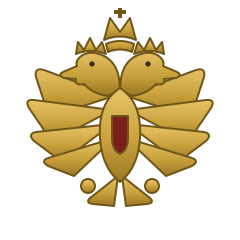
In 1472, Ivan III married Sophia Palaiologina, niece of the last Byzantine emperor, and adopted the double-headed eagle as the symbol of the Russian state. The symbolism was powerful: with the fall of Constantinople to the Ottomans in 1453, Moscow increasingly claimed to be the “Third Rome,” the spiritual and political heir to the Orthodox Christian empire. By the end of the fifteenth century, Muscovy was a major state, but it was still far from being an empire in the modern sense.
The conquest of the Tatar khanates
The second major phase of Russian expansion was the conquest of the Tatar khanates in the Volga region and the opening of the southern steppe. The Khanate of Kazan, a Muslim Tatar state on the middle Volga, was the first major target. Kazan had been a constant threat to the Muscovite state, raiding Russian settlements, blocking Russian expansion eastward, and refusing to accept Russian overlordship. In 1552, Ivan IV, Ivan the Terrible, launched a campaign against Kazan and captured the city after a brutal siege.
The fall of Kazan was followed in 1556 by the conquest of the Astrakhan Khanate, which controlled the lower Volga and the approaches to the Caspian Sea. The conquest of these two khanates gave Russia control of the entire Volga River, opening the way for Russian settlement of the rich black-earth regions of the south and providing access to the Caspian trade routes. The conquest also brought large Muslim populations under Russian rule, creating the multi-confessional character that would become a defining feature of the Russian Empire.
The Crimean Khanate, a Tatar successor state of the Golden Horde based on the Crimean peninsula, proved a more formidable opponent. Throughout the sixteenth and seventeenth centuries, Crimean Tatars conducted regular raids into Russian territory, capturing hundreds of thousands of people and selling them into slavery in the Ottoman Empire. The Crimean Khanate was not finally conquered until 1783, by Catherine the Great, but its raids were an important reason for the slow pace of Russian settlement in the southern steppe.
The conquest of Siberia
The third and most spectacular phase of Russian expansion was the conquest of Siberia, one of the most remarkable feats of colonization in world history. In 1581, the Cossack ataman Yermak Timofeyevich led a force of about 840 men across the Urals and into the territory of the Sibir Khanate, a Tatar state on the Irtysh River. After several battles, Yermak’s forces captured the khanate’s capital at Isker, and although Yermak was killed in 1585, the Russian advance continued.
The Russian conquest of Siberia was driven in large part by the fur trade. The sable, ermine, fox, and other furs of Siberia were enormously valuable, and the Russian state and its private adventurers were eager to exploit this wealth. The Stroganov family, wealthy merchants who had been granted extensive lands in the Urals by Ivan the Terrible, played an important role in organizing the initial expeditions. Once the fur-bearing regions were identified, Russian trappers, traders, and soldiers followed, establishing fortified outposts that would become cities.
The pace of Russian advance was astonishing. By 1610, the Russians had reached the Yenisei River. By 1628, they had reached the Lena. By 1632, they had founded Yakutsk on the Lena. By 1639, they had reached the Pacific Ocean at the Sea of Okhotsk, and by the 1640s they had reached the Amur River. The pace of expansion was so rapid in part because the Siberian peoples, including the various Tatar, Mongolic, and other groups, were generally too small in number and too poorly armed to mount sustained resistance. Larger peoples such as the Buryats and Yakuts fought back longer, but their resistance was eventually overcome by force, and the Russian presence in Siberia also involved extensive trade and accommodation with the indigenous peoples.
The construction of the Trans-Siberian Railway in the late nineteenth century finally brought Siberia firmly into the Russian economic and political system. The railway enabled large-scale Russian settlement of the region, the development of mining and industry, and the integration of the Far East into the Russian economy. It also brought the Russian Empire into conflict with Japan, leading to the Russo-Japanese War of 1904-1905.
The conquest of the Caucasus
The conquest of the Caucasus was one of the longest and most difficult campaigns in Russian imperial history. The region, located between the Black Sea and the Caspian Sea, was home to a wide variety of peoples, including Circassians, Chechens, Ingush, Avars, Lezgins, Ossetians, Georgians, Armenians, and many others, speaking a variety of languages and following different religions, including Orthodox Christianity, Islam, and various traditional beliefs.
The Russian advance into the Caucasus began in the late eighteenth century under Catherine the Great and continued throughout the nineteenth century. The region was incorporated into the empire in stages. Georgia, a Christian kingdom in the south Caucasus, sought Russian protection against the Persian and Ottoman empires and was absorbed in 1801, when Tsar Paul I issued a decree annexing the Georgian kingdom. The khanates of the eastern Caucasus were gradually absorbed, and the western Circassian coast was conquered in the 1860s, after a long and bitter war.
The most famous episode of the Russian conquest of the Caucasus was the Caucasus War of the nineteenth century, a long-running conflict centered on the resistance of the Muslim highlanders of the eastern Caucasus, particularly the Chechens and the Avars, under the leadership of the charismatic Imam Shamil. The war lasted for several decades, with the Russians using increasingly harsh tactics including the burning of villages, the destruction of crops, and the forced resettlement of the highlander population. The war ended in 1859 with the capture of Imam Shamil, but the Caucasus remained a region of unrest and resistance throughout the late imperial period.
The Russian conquest of the Caucasus was accompanied by a substantial exodus of the indigenous population, particularly the Circassians, who were expelled or fled to the Ottoman Empire in the 1860s. The Russian authorities also encouraged the settlement of Cossacks and Russian peasants in the region, which gradually transformed the demographic balance of the North Caucasus. The demographic consequence of the conquest was the displacement of most of the Circassian population to the Ottoman Empire between 1862 and 1867 — an event modern Circassian diaspora communities have pressed for recognition as genocide — and the replacement of indigenous populations with Cossack settlers and Russian peasants across the western Caucasus.
The conquest of Central Asia
The Russian conquest of Central Asia was the last major phase of Russian territorial expansion. The region, which today includes the independent states of Kazakhstan, Uzbekistan, Turkmenistan, Tajikistan, and Kyrgyzstan, was home to a number of Muslim states and a diverse population of settled agriculturalists and nomadic herders.
The Russian advance into Central Asia began in the early eighteenth century with the construction of a line of frontier fortresses along the steppe, but the major conquests came in the nineteenth century. The khanate of Khiva was defeated in 1873, the khanate of Kokand was annexed in 1876, and the Turkmen tribes of the Transcaspian were subdued in the 1870s and 1880s, the latter after a particularly brutal campaign against the Teke Turkmens in 1881, which ended with the massacre at the Geok Tepe fortress. The conquest of Central Asia was driven by a combination of strategic considerations, including the desire to protect the Russian frontier from raids by nomadic peoples, and economic motivations, including the desire to acquire cotton, raw materials, and markets for Russian industry.
The Russian conquest of Central Asia was also motivated by the great game, the strategic rivalry between Russia and Britain in central and southern Asia. The two empires competed for influence in Persia, Afghanistan, and the khanates, and the Russian advance toward the borders of British India was a major concern for the British. The Anglo-Russian Convention of 1907 divided Persia into spheres of influence and recognized Afghanistan as lying within the British sphere, defusing some of the tensions, but the strategic competition between Russia and Britain in central Asia remained an important feature of late imperial geopolitics.
The Russian administration of Central Asia involved a complex mixture of military government, indirect rule through local elites, and Russian settlement. The region was an important source of cotton for the Russian textile industry, and the construction of the Trans-Caspian Railway in the 1880s and 1890s integrated the region into the Russian economy. The Russian conquest also had a substantial cultural impact, bringing large numbers of Central Asian Muslims into contact with Russian administration, education, and culture, and laying the foundation for the development of modern national identities in the region.
Russian America and the Pacific
The Russian Empire also briefly established a colonial presence in North America. The Russian-American Company, a state-chartered trading company established in 1799, governed a vast territory in Alaska and the Pacific Northwest, including settlements at Sitka and Fort Ross in California; the company also briefly attempted to establish a foothold in Hawaii in the 1810s, but the effort was never consolidated and was soon abandoned. The Russian presence in North America was driven by the fur trade, especially the sea otter, and was limited in size and scope.
The Russian-American Company was not profitable, and the Russian government decided to sell Alaska to the United States in 1867 for $7.2 million. The sale, negotiated by the Russian minister Eduard de Stoeckl and the U.S. Secretary of State William Seward, was widely criticized in both countries at the time, but it is generally regarded as a shrewd move by the Russians, who were already overextended in their other colonial holdings and saw little prospect of holding Alaska in the long term. The purchase is often called “Seward’s Folly” by those who criticized it, but the subsequent discovery of gold and other resources in Alaska made the deal appear very advantageous to the United States.
The partitions of Poland
The partitions of Poland were one of the most dramatic events of the eighteenth century. The Polish-Lithuanian Commonwealth, a large and diverse state covering much of present-day Poland, Belarus, Ukraine, and the Baltic region, was in deep political crisis in the late eighteenth century, weakened by a unique political system that gave excessive power to the nobility and made effective government almost impossible.
In 1772, Russia, Prussia, and Austria, taking advantage of Polish weakness, agreed to the First Partition, by which each of the three powers annexed a portion of Polish territory. The Second Partition in 1793, and the Third Partition in 1795, eliminated the Polish-Lithuanian Commonwealth altogether. The three partitions brought vast new territories and populations into the Russian Empire, including much of what is today Belarus, Ukraine, and the Baltic region. They also created a Polish national question that would haunt the Russian Empire for the rest of its existence, with repeated Polish uprisings in 1830, 1863, and 1905.
Themes in Russian expansion
Four patterns recur across the imperial period.
Geography and the frontier. The vast Eurasian plain offered both opportunities and challenges. The openness of the steppe invited invasion, but it also offered room for expansion, and the long navigable rivers of Russia — the Volga, the Dnieper, the Don, and the great Siberian rivers — provided routes for trade and conquest. The frontier zones, including the steppe, the taiga, and the steppe-oasis belt of Central Asia, were where Russia was made, with the Cossacks, the fur traders, the Orthodox missionaries, and the imperial administrators all playing roles in the conquest and settlement of these regions.
The impact on the peoples conquered. The Russian Empire was a multi-ethnic and multi-confessional state, and the conquest brought Russian rule to a vast array of peoples with very different languages, religions, and traditions. The Russian approach varied widely, from the destruction of the khanates of Kazan and Sibir to the relatively respectful treatment of the Georgian Orthodox and the Christianised Finns, and from the harsh repressions of the Caucasus to the more accommodating policies of the Baltic provinces. The Soviet collapse in 1991 produced successor states largely within the borders the empire had drawn: the boundaries of the Baltic governorates, the Caucasian governorates, and the Central Asian oblasts became, with only minor adjustments, the independent state borders of Estonia, Latvia, Lithuania, Georgia, Armenia, Azerbaijan, Kazakhstan, Uzbekistan, Turkmenistan, Kyrgyzstan, and Tajikistan.
Expansion and development. The conquest of new territories provided Russia with access to new resources, including furs, minerals, and agricultural land, and it also provided a safety valve for social tensions, with the state encouraging the resettlement of peasants and others to the new territories. The colonisation of Siberia, the southern steppes, and the Caucasus transformed Russia from a relatively modest medieval state into a continental empire of vast dimensions.
The international context. The Russian Empire was never the only expanding power in Eurasia, and its expansion was often a response to the expansion of other powers, including the Ottoman Empire, the Swedish Empire, the Polish-Lithuanian Commonwealth, and the British Empire. The Great Game between Russia and Britain in central and southern Asia, the partitions of Poland with Prussia and Austria, and the complex diplomacy of the Napoleonic era all shaped the timing and direction of Russian expansion.