Rise of Muscovy and the Birth of Imperial Russia
The story of the Russian Empire begins with the rise of Muscovy, a small principality in the forests of northeastern Rus that, over the course of several centuries, grew into the most powerful state in Eastern Europe and laid the foundations for the empire that would eventually span the Eurasian continent. The rise of Muscovy is one of the great stories of medieval and early modern history, a complex process involving diplomacy, warfare, marriage, and the consolidation of political authority.
The transformation of Muscovy from a modest principality into an emerging imperial state was completed in 1547, when Grand Prince Ivan IV, known as Ivan the Terrible, was crowned as Tsar of All the Russias, claiming a sacred imperial authority derived from the Byzantine emperors. The coronation marked the formal beginning of the Tsardom of Russia and set the stage for the dramatic expansion that would eventually produce the Russian Empire.
The legacy of Kievan Rus
The historical roots of Muscovy lie in the early medieval state of Kievan Rus, a federation of East Slavic tribes that flourished from the ninth to the thirteenth centuries. Centered on the trade routes between the Baltic and the Black Sea, Kievan Rus adopted Eastern Orthodox Christianity in 988 under Prince Vladimir the Great, an event that bound the region culturally and spiritually to the Byzantine world.
Kievan Rus was not a centralized state in the modern sense. It was a federation of principalities ruled by a dynasty of princes descended from Rurik, a semi-legendary Varangian chieftain. The various principalities competed with each other for primacy, and the title of Grand Prince of Kiev, the senior member of the dynasty, was the object of constant rivalry. The system was held together by ties of kinship, by common acceptance of the Orthodox faith, and by the need to defend against external enemies, including the nomadic peoples of the steppe.
The Kievan state was severely damaged by a series of blows in the eleventh and twelfth centuries, including internal divisions, economic decline, and the rise of new centers of power in the western and northeastern parts of Rus. The final blow came in 1237-1240, when the Mongols, led by Batu Khan, invaded Rus and sacked Kiev in December 1240. The Mongol invasion shattered the Kievan state and left a patchwork of successor states, each struggling to survive in the new political environment.
The Mongol yoke
The period of Mongol domination, traditionally called the “Mongol yoke,” lasted from the 1240s until the late fifteenth century, and it had a profound effect on the development of Russia. The Mongols did not directly rule the Russian principalities but rather imposed a system of tribute and military service on them, leaving the local princes in place as long as they continued to deliver the tribute and provide military support.
The impact of the Mongol period on Russia is a matter of long-running historical debate. The traditional view, associated with nineteenth-century Slavophile historians, was that the Mongol yoke had been a major disaster that had retarded Russian development and isolated Russia from European civilization. The revisionist view, associated with the Eurasianist school of the twentieth century, was that the Mongol period had a more complex legacy, including the development of a centralized state apparatus, the introduction of certain administrative and military practices, and the integration of Russia into the larger Eurasian political and economic system.
The reality lies somewhere in between. The Mongol period was certainly destructive in the short term, with major population losses, economic disruption, and the destruction of urban centers. It also had significant long-term effects on the development of the Russian state, including the centralization of authority, the development of a system of military and postal service, and the experience of being part of a larger Eurasian political system. The Mongol legacy would remain a feature of Russian history for centuries to come.
The rise of Moscow
The most successful of the Russian principalities in the period of Mongol domination was Moscow. Moscow was a relatively small and unimportant principality in the early thirteenth century, but it had several advantages that would prove decisive in the long run. The principality was located in a relatively secure position in the upper Volga region, far from the main steppe routes. The Moscow princes were also adept at cultivating good relations with the Mongols, serving as tribute collectors for the Golden Horde and avoiding the most destructive invasions.
The first major step in the rise of Moscow was the leadership of Ivan I, known as Ivan Kalita or Ivan Moneybag, who ruled from 1325 to 1340. Ivan was appointed by the Mongol khan as the chief tax collector for the Russian principalities, a position that allowed him to accumulate wealth and to undercut his rivals. It was also under Ivan Kalita that Metropolitan Peter moved his residence to Moscow, making the city the seat of the Russian Church and giving its princes an important source of religious and political legitimacy.
The Moscow princes of the fourteenth century, including Simeon the Proud and Ivan II, continued the policy of accumulation and alliance. They took advantage of the divisions among the Mongol successors, the Golden Horde and the various successor khanates, to expand their territory and to assert their authority. They also gradually absorbed the other Russian principalities through a combination of diplomacy, purchase, and war.
The most important of the early Moscow rulers was Dmitry Donskoy, who ruled from 1359 to 1389. In 1380, Dmitry led a coalition of Russian princes to a significant victory over the Mongol forces at the Battle of Kulikovo on the Don River. The battle was not decisive in ending Mongol domination, but it was a symbolic victory that demonstrated the possibility of Russian resistance and helped establish Moscow as the leading Russian principality.
Ivan III and the consolidation of the Russian state
The ruler who completed Moscow’s rise to dominance was Ivan III, who ruled from 1462 to 1505 and is sometimes called Ivan the Great. Ivan III is the figure who most directly laid the foundations of the Russian imperial state. Under his rule, Moscow completed the absorption of the other Russian principalities, including the wealthy Novgorod Republic in 1478, the rival principality of Tver in 1485, and various other smaller states.
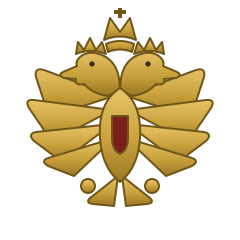
Ivan III also took two important steps that established the symbolic foundations of the future empire. In 1472, he married Sophia Palaiologina, the niece of the last Byzantine emperor, Constantine XI. The marriage was a diplomatic event, and it allowed Ivan to claim symbolic descent from the Byzantine imperial dynasty. He also adopted the double-headed eagle, the symbol of the Byzantine Empire, as the symbol of the Russian state.
The second symbolic step was the doctrine of Moscow as the “Third Rome.” The fall of Constantinople to the Ottoman Turks in 1453 had left the Orthodox world without an important political and religious center, and a Russian monk named Philotheus of Pskov formulated the doctrine that Moscow was now the “Third Rome,” the successor of Rome and Constantinople as the center of true Christian civilization. The doctrine was eventually to have an impact on Russian political culture, providing a religious and ideological framework for the expansion of the Russian state.
Ivan III also pursued an active foreign policy. He fought successful wars against the surviving Mongol successor states, including the Great Horde, and brought much of what is now European Russia under his control. He also began the long process of expansion that would eventually lead to the conquest of Siberia, the absorption of the Ukrainian lands, and the partition of Poland.
Ivan IV and the creation of the Tsardom
The most important step in the transformation of Muscovy into an imperial state was the reign of Ivan IV, known as Ivan the Terrible, who ruled from 1533 to 1584. Ivan’s reign was marked by dramatic territorial expansion, internal repression, and the transformation of the Russian state into the Tsardom of Russia.
Ivan came to the throne as a child, and his early reign was marked by the machinations of the boyar factions, who fought for influence over the young ruler. The period left a deep impression on Ivan and contributed to his deep distrust of the boyar class. In 1547, at the age of 16, Ivan was crowned as “Tsar and Grand Prince of All the Russias” in a ceremony that deliberately imitated the Byzantine imperial coronation. The title “Tsar,” derived from the Latin “Caesar,” was a claim to imperial authority and a declaration that Moscow was the equal of the surviving imperial powers.
The new tsar pursued a program of territorial expansion. In 1552, he led a campaign against the Khanate of Kazan, a Muslim Tatar state on the middle Volga, and captured the city after a long siege. The conquest of Kazan was followed in 1556 by the conquest of the Astrakhan Khanate, which controlled the lower Volga and the approaches to the Caspian Sea. The conquest of these two khanates gave Russia control of the entire Volga River, opened the way for Russian settlement of the south, and brought large Muslim populations under Russian rule.
Ivan also began the Russian expansion into Siberia. In 1581, the Cossack ataman Yermak Timofeyevich led a force across the Urals and into the territory of the Sibir Khanate. Yermak was killed in 1585, but the Russian advance continued, and within a few decades the Russians had reached the Pacific Ocean.
The second half of Ivan’s reign was marked by the Oprichnina, a reign of terror against the boyar class and the larger Russian population. Ivan divided the country into two parts, the Oprichnina and the Zemshchina, and unleashed a force of Oprichniki, his personal guards, to hunt down and destroy his real and imagined enemies. Thousands of people were killed or dispossessed, and the period left a deep scar on Russian political culture.
The Time of Troubles
Ivan’s death in 1584 was followed by a period of crisis and instability. His son Fyodor I, the last of the Rurikid dynasty, died without an heir in 1598, and the extinction of the dynasty led to a succession crisis. The period that followed, called the Time of Troubles (1598-1613), was one of the most difficult in Russian history. Foreign intervention, pretender tsars, peasant rebellions, and Cossack revolts convulsed the country, and the existence of the Russian state itself was in question.
The crisis was eventually resolved in 1613, when a national assembly called the Zemsky Sobor elected the young Michael Romanov as the new tsar. The election ended the Time of Troubles and established the Romanov dynasty, which would rule Russia for the next 304 years. The work of consolidating the Russian state, however, had been seriously disrupted, and the early Romanovs faced the enormous task of restoring order and rebuilding the country.
The legacy of Muscovy
The rise of Muscovy and the creation of the Tsardom of Russia was one of the events of early modern history. By the end of the sixteenth century, Russia had become a European and Asian state, with a vast territory, a centralized government, and a distinct political culture. The expansion of the Russian state had also created a multi-ethnic and multi-confessional state, with significant Muslim, Finno-Ugric, and other non-Russian populations.
The legacy of the Muscovite period would shape Russian history for centuries. The autocratic system of government, the close connection between Church and state, the emphasis on territorial expansion, and the experience of governing a multi-ethnic state all had their origins in this period. The figure of the tsar as the supreme ruler, head of the Church, and commander of the army would remain central to Russian political culture until the fall of the empire in 1917.
The work of Peter the Great in transforming Russia into a modern European power and proclaiming the Russian Empire in 1721 was thus built on foundations that had been laid by the long process of Muscovite expansion and consolidation. The empire of the Romanovs emerged from the principality of Moscow, and the long process of imperial state-building that began in the forests of the upper Volga would eventually produce the largest empire in the modern world.