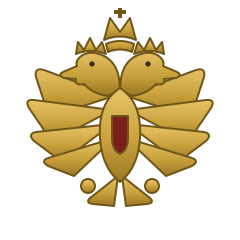
What Was the Russian Empire’s Coat of Arms?
The double-headed eagle was adopted as the symbol of the Russian state in 1497, when Grand Prince Ivan III married Sophia Palaiologina, the niece of the last Byzantine emperor, and began to use the imperial arms of the Palaiologos. The earliest Russian seal showing the double-headed eagle dates from 1497 and is paired with a mounted rider spearing a dragon — the figure later identified with St George, the patron of Moscow. The eagle was the personal and dynastic arms of the Grand Prince, and it remained the principal emblem of the Russian state, in increasingly elaborate forms, until 1917 (see de Madariaga, Ivan the Terrible, 2005).
The imperial arms of the Romanovs
The Romanovs developed the double-headed eagle in the seventeenth and eighteenth centuries. The 1625 seal of Michael I was the first to use the eagle in a form clearly derived from the Palaiologan model. By the time of Peter the Great, the eagle was the centre of a more elaborate design: Peter added the chain of the Order of St Andrew, the escutcheons of the major principalities, the scepter and orb, and the four small escutcheons representing the conquered territories (Kazan, Astrakhan, Siberia, and the Tauris). The 1721 proclamation of the Empire was marked by the addition of the scepter and orb, the title of the Empire, and a new grandeur to the design.
The most elaborate version was the 1882 coat of arms, fixed by Tsar Alexander III in a decree of 11 April 1882, and designed by the heraldist Alexander Baryshnikov. The 1882 arms had the double-headed eagle at the centre, with the four traditional small escutcheons (Kazan, Astrakhan, Siberia, and Tauris) at the tops of the wings, the central escutcheon of St George, the chain of the Order of St Andrew around the eagle, the scepter and orb in the claws, the Imperial Crown above the eagle’s heads, the banners of the principal military orders to either side, and the additional small escutcheons of the principal Russian territories (Poland, Finland, the Caucasus, Khiva, Bukhara, and the various other conquests). The 1882 arms were the official Russian state arms until 1917 (Bobrov, Russkaia geraldika, 2002).
The territorial escutcheons
The territorial escutcheons on the imperial arms were a small atlas of the Russian Empire. The central escutcheon of St George, the symbol of Moscow, was joined over time by the arms of the major territories: the Kingdom of Poland (the white eagle on a red field), the Grand Duchy of Finland (the crowned lion on a red field), the Tauris (the Crimean arms), the Khivan Khanate, the Bukharan Emirate, and others. The combined arms of 1882 included about thirty separate heraldic elements, with the double-headed eagle at the centre, making it one of the most complex state arms of the period (Bobrov, 2002).
The 1917 abolition and the post-Soviet revival
The imperial arms were abolished in 1917, in the early months of the Russian Republic. The Provisional Government removed the imperial symbols and adopted a new state seal. The Soviet government that followed used a new design, the hammer and sickle in a wreath, in 1923. After 1991, the Russian Federation moved to a new state emblem, the double-headed eagle restored as the central figure, in a Federal Constitutional Law of 25 December 2000.
The 1993 arms are modelled on the 1882 imperial arms, but with several deliberate differences. The imperial crown has been removed; the scepter and orb are gone; the imperial motto has been replaced with the Russian Federation’s state motto. The four small escutcheons of the imperial period have been removed. The result is an emblem that, in its visual form, deliberately recalls the imperial arms, but is no longer the arms of a hereditary monarchy (Russian Federation, 2000).
The eagle in Russian culture
The double-headed eagle was, throughout the imperial period, the central state symbol. It appeared on the imperial standards, on the coinage, on the uniforms of the imperial regiments, on the orders and decorations, and on the official seals. It was the working symbol of the state in the way that the monarch’s portrait is in other European countries.
The eagle’s cultural meaning was contested. The Western-reading Russian liberal public of the late nineteenth century was often uneasy with the Byzantine symbolism; the Russian nationalist and Slavophile movements of the period identified the eagle with the imperial and Orthodox tradition. After 1991, the question of how far the post-Soviet Russian state was inheriting the imperial symbol was a live political issue, and the 2000 law on the state emblem was, in part, a decision to do so (Wortman, Scenarios of Power, 1995-2000).