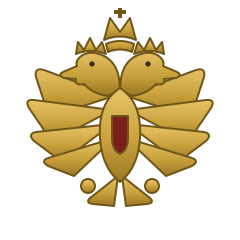
What Was the Provisional Government?
On the evening of 2 March 1917 (15 March by the Western calendar), in a railway carriage in Pskov, Tsar Nicholas II signed the document of abdication in favour of his brother Grand Duke Michael. A second abdication followed at 3 am the next day, when Michael himself renounced the throne and transferred sovereignty to the Provisional Government. The Provisional Government, formed the same day in the Tauride Palace from the Provisional Committee of the State Duma, lasted 237 days. It was overthrown on 25-26 October 1917 (7-8 November by the Western calendar) by the Bolsheviks, in an insurrection so bloodless that the Red Guards’ losses in the city of Petrograd were fewer than six. The Provisional Government, in other words, is the eight months of Russian history between the fall of the Romanovs and the Bolshevik seizure of power (see Pipes, The Russian Revolution, 1990; Figes, A People’s Tragedy, 1996).
The formation
The Provisional Government was the creation of the Provisional Committee of the State Duma, a body of about a dozen deputies who had gathered on 27 February in the Tauride Palace under Mikhail Rodzianko, the Duma chairman. The Committee was forced to act when the Petrograd garrison mutinied, the Petrograd Soviet was formed in parallel by the workers’ and soldiers’ deputies, and the Duma itself was clearly unable to govern. The Committee chose as its chairman the Constitutional Democrat Pavel Milyukov, the foreign affairs specialist, and as its chairman of the Cabinet the liberal Prince Georgy Lvov, a moderate and an experienced zemstvo leader. The cabinet was composed mainly of the deputies of the Constitutional Democratic Party and the moderate Octobrists, with a small representation of the Socialist Revolutionaries and Mensheviks in the secondary positions.
The Provisional Government claimed to be the legitimate successor to the imperial government, and it was recognised as such by the Allied powers within a week. It was, however, forced to share power with the Petrograd Soviet, which represented the workers and the soldiers, and which issued the famous Order No. 1 of 28 February establishing a network of soldier committees in the army. The Provisional Government and the Petrograd Soviet sat in the same building and ruled Russia together — a situation that the Russian Marxists called dvoyevlastie, “dual power” (Figes, 1996).
The government and its policies
The Provisional Government was a coalition of liberals and moderate socialists. Its first cabinet, formed on 2 March 1917, contained one representative of the Socialist Revolutionaries (the veteran revolutionary Alexander Kerensky as minister of justice) and two representatives of the Mensheviks (in minor posts). The second cabinet, formed on 5 May 1917 after the April Crisis, contained six Socialist Revolutionaries and Mensheviks alongside the Constitutional Democrats. The third cabinet, formed on 8 July 1917 after the July Days, was a coalition of socialists led by Kerensky. The fourth cabinet, formed on 25 September 1917 after the Kornilov Affair, was a five-man Directory of Kerensky and four others.
The government issued a series of decrees in its first week: the abolition of the death penalty, the introduction of civil liberties, the release of political prisoners, the recognition of Polish independence, and the call for a Constituent Assembly. It did not, however, issue a land decree (the question was left to the Assembly), did not end the war (Milyukov’s note of 18 April 1917 promising the allies that Russia would fight to victory produced the April Crisis and Milyukov’s resignation), and did not establish a formal state ideology. The government was, in effect, an interim liberal regime committed to a constitutional and democratic Russia (Pipes, 1990).
The crises of 1917
The Provisional Government was forced to deal with four major crises in 1917.
The April Crisis (18-21 April) was triggered by Milyukov’s note to the allies reaffirming Russia’s commitment to the war. The note was leaked to the Soviet, the Soviet passed a resolution of no confidence, and the workers and soldiers of Petrograd took to the streets. Milyukov was forced to resign; the government was reorganised with a socialist majority; and the principle of “no annexations, no indemnities” was written into the coalition agreement.
The July Days (3-7 July) were the next crisis. The Bolsheviks, growing in strength in the Soviets, called for an armed demonstration under the slogan “All Power to the Soviets.” About 500,000 workers and soldiers marched through Petrograd; the government, now led by Kerensky, suppressed the demonstration with loyal troops. The Bolsheviks were forced into hiding; Trotsky and Kamenev were arrested. Lenin escaped to Finland.
The Kornilov Affair (27-30 August 1917) was the most serious. General Lavr Kornilov, the newly appointed commander-in-chief, attempted a military coup against the Provisional Government, with the apparent support of some conservative politicians. The coup failed partly because of the railway workers, who refused to transport the coup troops, and partly because the Petrograd Soviet organised the defence of the capital. The Kornilov Affair, however, strengthened the Bolsheviks, who had helped to organise the defence, and it polarised Russian society between the moderate and the radical wings of the revolution.
The Bolshevik seizure of power (25-26 October 1917) was the final crisis. The Bolsheviks, with the support of the Petrograd garrison, occupied the bridges, the railway stations, the post office, and the central telegraph office. The cruiser Aurora fired a blank shot as the signal for the assault on the Winter Palace, the Provisional Government was arrested, and the Council of People’s Commissars under Lenin was proclaimed. The Provisional Government had lasted 237 days (Figes, 1996).
The legacy
The Provisional Government was the first serious attempt at Russian parliamentary democracy. Its constitution and its decrees became the foundation of the post-Soviet Russian constitutional order. Its foreign policy, the brief experiment with peace without victory and the principle of self-determination, was a precursor of the post-1945 European settlement. Its failure is one of the most-studied questions in modern history; the historian Richard Pipes, in his The Russian Revolution (1990), puts the weight on the strategic and the political, while Orlando Figes, in A People’s Tragedy (1996), puts the weight on the social and the cultural. The Provisional Government was the regime that the Russian imperial political class managed to assemble, in the few hours between the fall of the Romanovs and the Bolshevik victory; it was the regime that the Bolsheviks found it easy to defeat (Pipes, 1990; Figes, 1996).