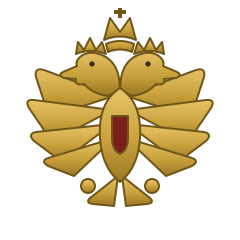
The Imperial Russian Army
The Imperial Russian Army was one of the largest standing armies in the world for most of the imperial period, and it played a central role in Russian history, both in the expansion of the empire and in the development of Russian society. From Peter the Great’s reforms in the early eighteenth century to the collapse of the empire in 1917, the Russian army was a defining institution of the Russian state, shaping the political system, the social structure, and the economic development of the country.
The army was more than just a military force. It was an employer, a school for the elite, a tool of social mobility, and an important force in the development of Russian industry and infrastructure. The conscription system brought millions of young men from peasant families into military service, exposing them to new ideas, new skills, and new contacts. The officer corps was drawn from the nobility, and military service was a key avenue of social advancement. The army’s demands for rifles, ammunition, uniforms, and other supplies drove the development of Russian industry, and the army’s need for transportation led to the construction of the railways and the modernization of the road system.
Understanding the Imperial Russian Army is essential for understanding the history of the Russian Empire. The army’s successes and failures shaped the political destiny of the country, and the army’s eventual collapse in 1917 was both a cause and a consequence of the empire’s fall.
The origins of the Imperial Russian Army
The Imperial Russian Army traces its origins to the military reforms of Peter the Great in the late seventeenth and early eighteenth centuries. Before Peter, the Russian military was organized in the medieval manner, with a core of noble cavalry, semi-professional infantry, and various auxiliary forces. The system was poorly suited to the demands of large-scale, sustained warfare, and the early campaigns of Peter’s Great Northern War against Sweden, particularly the catastrophic Russian defeat at the Battle of Narva in 1700, made the need for reform obvious.
Peter’s military reforms transformed the Russian army into a modern regular force. The central innovation was the introduction of conscription, which began in 1705 and was based on a system of recruit levies that fell on the whole taxable population, including the privately owned serfs as well as the state and court peasants, with one man to be provided for every twenty or thirty households. The conscripted men, or rekruts, served for life, although this was later reduced to a fixed term of service. The conscripts were organized into regiments along European lines, with standard uniforms, weapons, drill, and discipline.
Peter also established a network of military schools, including the Artillery and Engineering School in Moscow, to provide trained officers. The Table of Ranks of 1722 organized military service into fourteen grades, with corresponding civil equivalents, and provided a path for talented commoners and foreigners to enter the nobility. Many foreign officers, including Scots, Germans, and French, served in the Russian army during the eighteenth century, especially in the early years before a sufficient number of native Russian officers had been trained.
Organization and structure
The Imperial Russian Army was organized into a hierarchy of units, from regiments and divisions up to corps and armies. The basic unit was the regiment, which typically had about 1,000 to 2,000 men, and which was the principal unit of tactical maneuver. The regiment was typically commanded by a colonel, and the regimental staff was responsible for the training, discipline, and administration of the regiment.
The next level was the division, which typically consisted of two or more regiments, plus supporting artillery, cavalry, and other units. The division was typically commanded by a general, and it was the principal unit of operational maneuver. Above the division was the corps, which typically consisted of two or more divisions, plus supporting units. The corps was the principal unit of strategic maneuver, and it was typically commanded by a lieutenant general.
The highest level of organization was the army, which typically consisted of several corps, plus reserve units and supporting services. The army was the principal strategic formation, and it was typically commanded by a general. The most important strategic formations in the First World War were the Northern, Western, and Southwestern Fronts, each of which included several armies.
The army was supported by a complex logistics system, including supply trains, hospitals, arsenals, and depots. The supply system was often inadequate, especially in the early stages of the First World War, and the army’s ability to fight was often limited by the lack of rifles, ammunition, and other supplies. The introduction of the railways in the second half of the nineteenth century greatly improved the army’s ability to mobilize and to sustain operations, but the Russian railway system remained less developed than those of the other European powers.
Officer corps and military education
The officer corps of the Imperial Russian Army was drawn primarily from the nobility, and military service was a key avenue of social advancement. The sons of noble families typically entered military service as young men, often in the prestigious Guards regiments, which were based in St. Petersburg and served as a sort of finishing school for the imperial elite. The Guards were also politically important: palace coups and the making and unmaking of emperors often involved the Guards, and their support was an important factor in determining who sat on the Russian throne.
The most important military schools were the Page Corps, the Cadet Corps, and the special military academies for artillery, engineering, and general staff. The most prestigious was the Imperial Nicholas General Staff Academy, which trained officers for the general staff and which produced many of the most important Russian military commanders.
The officer corps was generally well-educated by the standards of the time, and the Russian military made significant contributions to European military thought in the second half of the nineteenth century. Principal Russian military theorists of the late nineteenth century, including G.A. Leer and M.I. Dragomirov, developed important ideas about the conduct of war, the training of troops, and the role of the officer corps. The Russian military tradition emphasized the importance of offensive action, the role of the bayonet, and the moral qualities of the troops and their commanders.
The late nineteenth century saw a significant deterioration in the quality of the Russian officer corps. The introduction of universal conscription, the growth of the army, and the increasing complexity of modern warfare required a much larger officer corps than the nobility could provide, and the regime was forced to recruit officers from a wider range of social backgrounds. The result was a decline in the prestige and effectiveness of the officer corps, and a growing gap between the officers and the troops. The situation was exacerbated by poor pay, harsh discipline, and the lack of respect for the officers among the troops.
Major campaigns and battles
The Imperial Russian Army fought a long series of campaigns during the imperial period. The first campaign was the Great Northern War against Sweden (1700-1721), which ended with the Russian victory at Poltava in 1709 and the Treaty of Nystad in 1721. The war established Russia as a European power and gave it access to the Baltic Sea.
The army fought a series of wars against the Ottoman Empire in the eighteenth and nineteenth centuries, including the Russo-Turkish Wars of 1768-1774, 1787-1792, 1806-1812, 1828-1829, and 1877-1878. The most important of these was the war of 1768-1774, which ended with the Treaty of Küçük Kaynarca and gave Russia access to the Black Sea, and the war of 1877-1878, which was fought largely in Bulgaria and ended with the Treaty of San Stefano, later revised at the Congress of Berlin.
The most important Russian military campaign of the nineteenth century was the war against Napoleon in 1812-1814. The Russian campaign of 1812, in which the Russian army defeated Napoleon’s Grande Armée, was a turning point in European history, and the European campaigns of 1813-1814 led to the occupation of Paris and the restoration of the European order.
The most important Russian military campaign of the twentieth century was the First World War, in which the Russian army suffered catastrophic losses but also achieved some major successes. The Brusilov Offensive of 1916, led by General Aleksei Brusilov, was one of the most successful Russian operations of the war, and it forced Germany to transfer significant forces from the Western Front. The Russian army’s overall performance in the war, however, was undermined by poor leadership, inadequate supply, and the increasing revolutionary sentiment among the troops.
The army in the revolutions of 1917
The role of the army in the revolutions of 1917 was decisive. The February Revolution began with a mutiny in the Petrograd garrison, and the army’s refusal to support the regime was the immediate cause of the tsar’s abdication. The Provisional Government that followed attempted to continue the war, but the army was increasingly unwilling to fight, and desertions became widespread.
The October Revolution was made possible in part by the support of significant parts of the Petrograd garrison, and the Bolsheviks’ promises of “Peace, Land, and Bread” appealed to the war-weary soldiers. The subsequent Russian Civil War saw the Bolsheviks build a new Red Army under the command of Leon Trotsky, which eventually defeated the White armies and other opponents.
The collapse of the Imperial Russian Army was a major event in itself. The army that had numbered more than six million men in 1916 had effectively ceased to exist as a coherent fighting force by early 1918, and the soldiers had returned to their villages, often bringing with them revolutionary ideas and weapons. The legacy of the army’s collapse would shape the early Soviet period and would contribute to the difficulties of the new Soviet state in the years that followed.